
School Website Compliance: What You Have to Publish
Every maintained school in England has to publish a set list of information on its website, and academies publish a comparable list through their funding agreement. It is long, it changes, and it is one of the first things an inspector looks at. This is the plain English version, split properly between maintained schools and academy trusts.
We build this structure into every website we make, so it stays findable and current.
Maintained school or academy? The lists are different
This trips up a lot of schools. The DfE publishes two separate pieces of guidance, and a fair amount of what is a legal must for a maintained school reaches an academy through its funding agreement and the Academy Trust Handbook instead. Academy trusts also publish things at trust level that maintained schools never deal with at all.
- Maintained schools: What maintained schools must publish online, gov.uk
- Academies and trusts: What academies, free schools and colleges should publish online, gov.uk
What maintained schools must publish
These are the items a maintained school in England is required to publish on its website. Where something only applies to certain schools, that is noted.
| Item | What it covers |
|---|---|
| Admission arrangements | Your arrangements for the normal point of entry, in year procedures and the appeals timetable. Applies to foundation and voluntary aided schools that set their own arrangements. |
| Behaviour policy | Required under the Education and Inspections Act 2006. |
| Careers programme Secondary | The name and contact details of your careers lead, a summary of the programme, how you measure its impact and the review date, plus the provider access policy statement. |
| Charging and remissions | Which activities you charge for and the circumstances in which charges are waived. |
| Complaints policy | Your formal complaints procedure, including the arrangements for handling SEN complaints. |
| Contact details | Postal address, telephone number, the named member of staff who deals with queries, and your SENCO’s details if you are a mainstream school. |
| Curriculum | Content for each subject in each academic year, the right to withdraw from RE, your accessibility plan, your phonics and reading scheme at KS1, and your KS4 course list. |
| Financial information | The number of employees earning over £100,000, in bands of £10,000, and a link to the schools financial benchmarking service. |
| Governance information | Information about your governing body and its committees, and how its constitution meets the requirements. |
| Ofsted reports | Your most recent report, or a link to it. |
| Pay gap reporting 250+ staff | Gender pay gap information published through the government service within a year of the snapshot date. |
| PE and sport premium | How much you received, how you spent it, the impact on participation and attainment, how you will sustain it, and the percentage of Year 6 who can meet each swimming requirement. |
| Public sector equality duty | How you comply, published annually, plus equality objectives at least every four years. |
| Pupil premium | Your strategy statement, published by 31 December each year, how the money was spent and the outcomes for disadvantaged pupils. |
| SEND information | Your SEN information report, updated annually, admission arrangements for disabled pupils, the steps you take to prevent less favourable treatment, the facilities that improve access, and your accessibility plan. |
| Results | A link to the compare school and college performance service, plus your KS2, KS4 or KS5 measures as they apply to you. |
| Item | What it covers |
|---|---|
| Ethos and values Should | What your school stands for. Not required, but it is usually the thing prospective families read first. |
| Music development plan Should | A summary of your music provision. |
| Detailed governance Should | Structure and remits, full names of chairs and individual governors, appointment dates, attendance records, business interests, and governance diversity data. |
| Remote education Should | What provision looks like if pupils cannot attend in person. |
| School opening hours Should | Start and finish times and the total weekly hours. |
| School uniform Should | The items required, which carry branding, where they can be bought and what is available second hand. |
| Destinations and EBacc Should | Post 16 destinations, EBacc participation and average point scores. |
What academies and academy trusts publish
Academies publish at two levels. The trust publishes a set of items that maintained schools never deal with, and each academy publishes its own list. The trust level items are the ones most often missed.
| Item | Notes |
|---|---|
| Funding agreements | The trust’s agreements with the Secretary of State. |
| Memorandum and articles of association | The trust’s governing documents. |
| Audited annual report and accounts | Published by 31 January each year. |
| Executive pay | Details of senior staff pay as set out in the Academy Trust Handbook. |
| Whistleblowing procedures | How concerns can be raised and how they are handled. |
| Gender pay gap 250+ staff | Where the trust employs 250 or more people. |
| Item | Notes |
|---|---|
| Admission arrangements | Published by 15 March each year. |
| Pupil premium strategy | Published by 31 December each year. |
| SEN information report | Updated annually. |
| Careers provider access statement | Required under section 42B of the Education Act 1997. |
| Complaints procedure | Meeting the Education (Independent School Standards) Regulations 2014. |
| Relationships and sex education policy | Developed with parental consultation. |
| PE and sport premium | Spend, impact and sustainability, as for maintained schools. |
| Public sector equality duty | Compliance annually and objectives at least every four years. |
| Pay gap reporting 250+ staff | Where the employer has 250 or more staff. |
| Behaviour, charging, curriculum, contact details, ethos, Ofsted, uniform, opening hours, remote education, results Should | The DfE guidance lists these as items academies should publish rather than must, though many are picked up through the funding agreement. |
If you run a trust, our academy trust websites page explains how we handle publishing across a whole estate, so a policy goes up once rather than fifteen times.
The compliance calendar
Four fixed dates catch schools out more than anything else, because they land in the middle of terms when nobody is thinking about the website.
Pupil premium strategy
Your strategy statement for the current year, including how the funding is spent and the outcomes for disadvantaged pupils.
Trust accounts Trusts
The audited annual report and accounts, published on the trust website.
Admission arrangements Academies
Determined admission arrangements for the following year.
SEN report and equality duty
The SEN information report is updated every year, as is your public sector equality duty compliance. Equality objectives run on a four year cycle.
We build the structure in from day one
The usual pattern is that statutory information gets added at the end of a website project, dropped into a single page called Statutory Information, and slowly turns into a wall of PDFs that nobody can navigate.
We plan it in at the design stage instead. Every required item gets its own permanent, properly labelled home in the site structure, so an inspector, a governor or a parent can find it, and so your team knows exactly where each thing goes when it needs updating.
Policies that tell you when they are due
Most compliance failures aren’t about missing pages. They are about a policy that expired eighteen months ago and nobody noticed, or a strategy statement still showing last year’s figures.
Our policy library holds review dates against each document and flags them when they come round, so the problem surfaces before an inspector finds it rather than afterwards.
We tell you when the guidance moves
The DfE updates this guidance periodically, and the changes rarely make it to anyone in a school office. A requirement gets added and hundreds of school websites quietly fall out of date.
We watch the guidance and tell our schools when something changes, along with what it means for your site. If a new item is needed, we add the structure for it.
Compliance built in, not bolted on
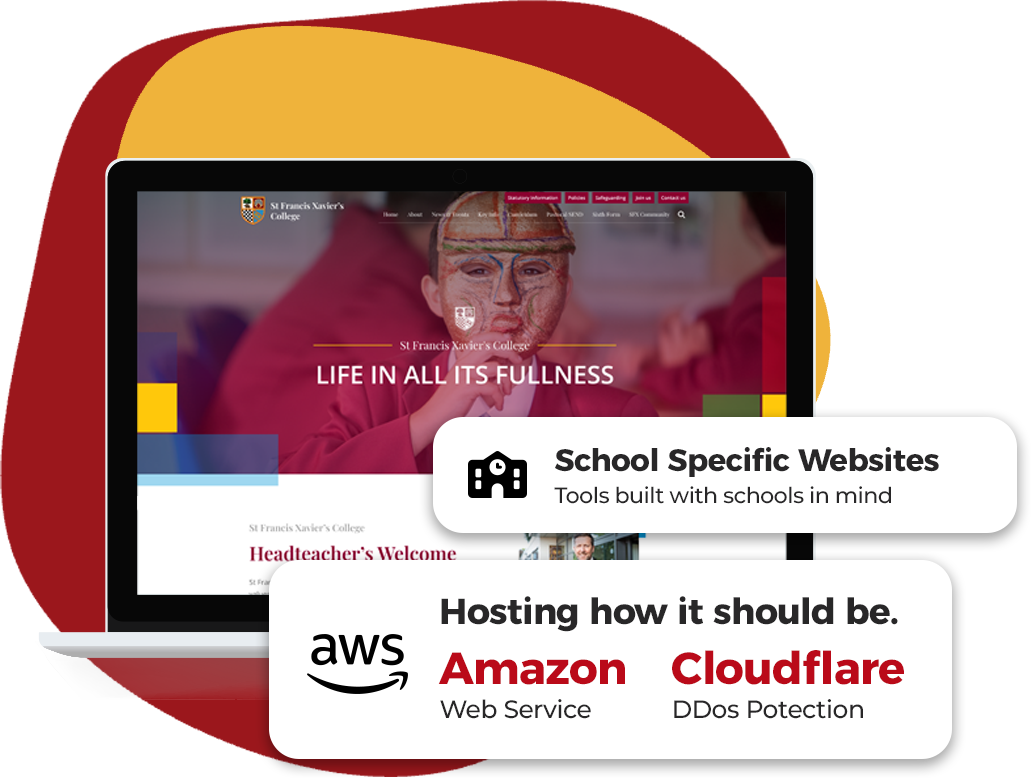
On a Realsmart website the statutory pages are part of the structure from the start, so nobody is rebuilding the list from scratch every time something changes.
- Every required item has its own permanent home
- Split correctly for maintained schools or academy trusts
- Policy review dates flagged before they run out
- We tell you when the DfE guidance changes
School website compliance FAQs
What must a school publish on its website in England?
Maintained schools must publish admission arrangements, behaviour policy, charging and remissions, complaints policy, contact details, curriculum information, financial information, governance information, Ofsted reports, PE and sport premium, public sector equality duty information, pupil premium strategy, SEND information and results. Secondary schools must also publish their careers programme and provider access statement. Academies publish a comparable list through their funding agreement, plus trust level items such as funding agreements and audited accounts.
Is the list different for academies and maintained schools?
Yes, and it matters. The DfE publishes separate guidance for each. Several things that are a legal must for a maintained school reach an academy through its funding agreement and the Academy Trust Handbook instead, and academy trusts publish items at trust level that maintained schools never deal with.
Does Ofsted check the school website?
Inspectors routinely look at a school’s website before and during inspection, and missing statutory information is usually picked up. It is one of the easiest things to get right in advance, which is why it is frustrating when it goes wrong.
When was the DfE guidance last updated?
Both the maintained schools guidance and the academies guidance were last updated on 24 October 2024. We reviewed this page on 13 August 2026. The Academy Trust Handbook 2025 applies until the 2026 handbook takes effect on 1 October 2026.
What are the key deadlines?
Pupil premium strategy by 31 December. Trust audited accounts by 31 January. Academy admission arrangements by 15 March. The SEN information report and public sector equality duty compliance are annual, and equality objectives run on a four year cycle.
Do we have to publish financial information?
Maintained schools publish the number of employees earning over £100,000 in bands of £10,000, along with a link to the schools financial benchmarking service. Academy trusts publish their audited annual report and accounts by 31 January, along with executive pay details.
Who is responsible for keeping the website compliant?
The school or trust is, because only you have the figures, the policies and the dates. What we do is make sure every required item has somewhere to live, flag policies when they are due for review, and tell you when the DfE guidance changes so nothing slips by unnoticed.
Does a Realsmart website keep us compliant automatically?
We build the structure so that every required item has a permanent home, our policy library flags documents when they are due for review, and we tell you when the DfE guidance changes. The content itself still has to come from you, because only your school knows your figures and your policies.
More on school websites
More on keeping a school website compliant and current.
Ensuring your website is Ofsted compliant
The checks worth doing on your website before an inspection.
Sync your website policies with Google Drive or OneDrive
Keep your policy library up to date without uploading anything twice.
The anatomy of a school website
The sections every school website needs, and where parents look for them.
Talk to us about your school website
Book a free demo and we will show you how the statutory pages are structured on a Realsmart site, walk you through the content management system and answer any questions about cost.